
Recovery Fatigue...
The exhaustion that comes from constantly trying to recover.

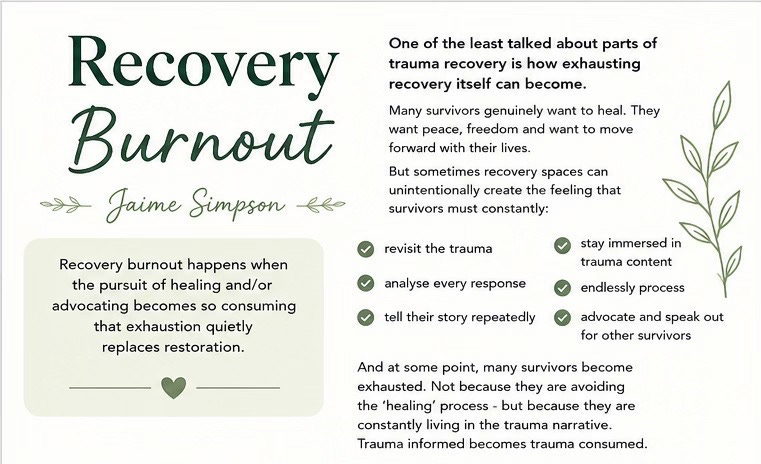
Recovery burnout can become difficult to recognise because sometimes it becomes intertwined with the original injury itself.
There can be an unspoken pressure, both internally and externally, to appear healed or recovered, strong, insightful, resilient, or inspiring once you begin speaking publicly about your experiences. And that pressure can make it difficult to recognise when your nervous system is no longer functioning from restoration, but from exhaustion.
With each retelling.
With each journal entry.
With each disclosure.
With each late-night scroll through trauma content.
With each journalist contacting you.
With each survivor reaching out to you….
Slowly, your nervous system may start to carry more and more emotional weight until eventually recovery exhaustion takes over.
At that point, it can become difficult to distinguish whether you are responding to the original injury and trauma triggers, or whether your nervous system has moved into burnout from the constant work of surviving, processing, speaking and carrying your own, and other peoples’ trauma.
Remember:
Most survivors and advocates are not trained therapists, yet people often expect survivors to somehow hold the answers, absorb everyone’s pain, provide emotional support, educate others, advocate publicly, and still continue managing their own healing at the same time.
It is okay to take the pressure off yourself if you are not trained in this space.
And even when you are trained, it is still okay to acknowledge when the emotional labour you are carrying is draining you more than it is restoring you, especially when you are giving your time, energy, advocacy, education, or support for free.
Compassion should not require self-abandonment.
You are allowed to have boundaries.
You are allowed to protect your nervous system.
You are allowed to stop carrying responsibilities that were never meant to belong to you alone.
Surviving abuse does not automatically make someone emotionally limitless.
Many survivors are still actively navigating their own recovery while simultaneously carrying the weight of disclosures, advocacy, public education, and the emotional expectations of others.
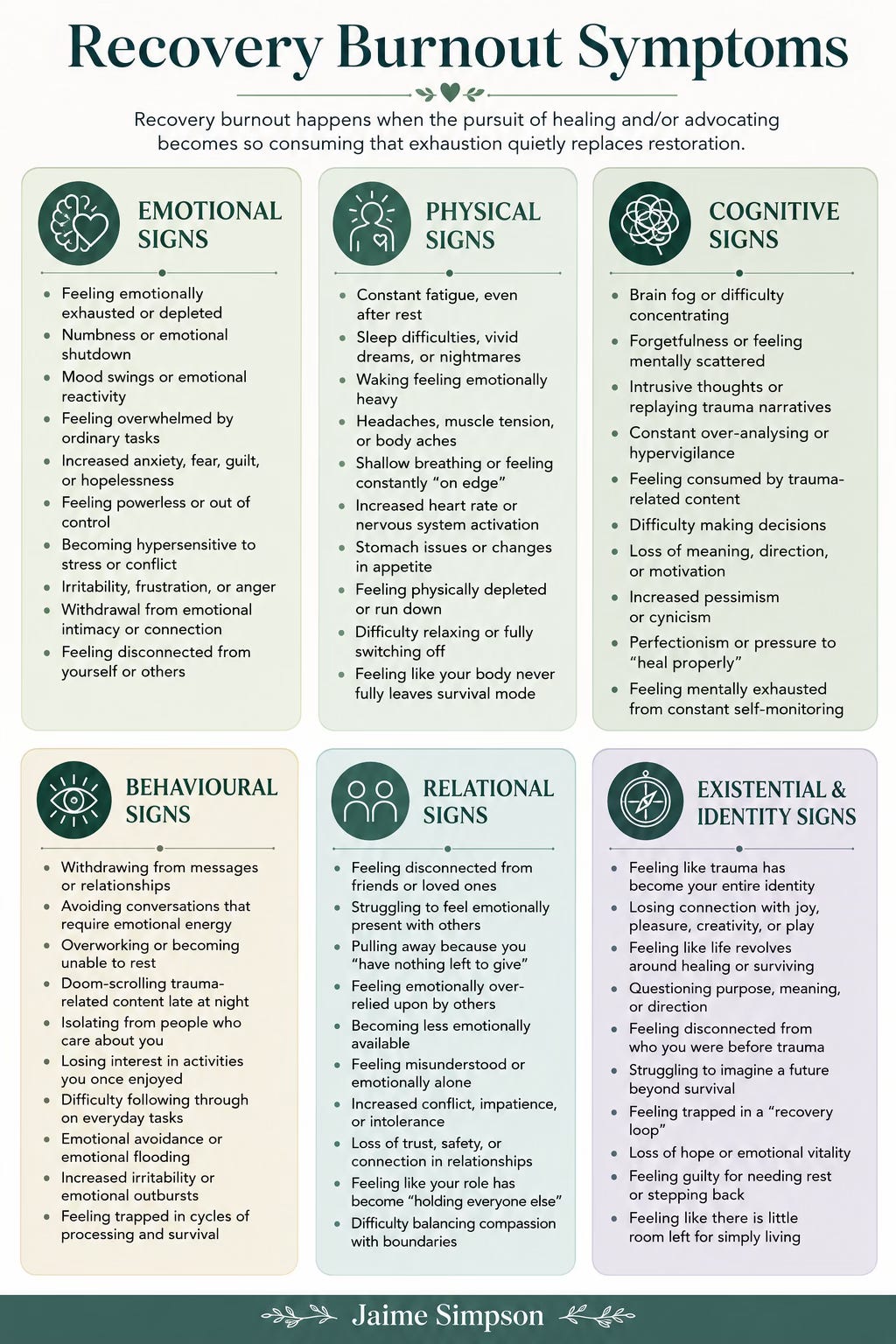
Practically it may look like
Struggling to answer messages
Even from people you love. Not because you do not care, but because your nervous system cannot tolerate one more emotionally loaded conversation.
Feeling emotionally numb, detached, irritable, or foggy
You may notice yourself struggling to concentrate, forgetting things, losing motivation, feeling increasingly overwhelmed by small decisions, or withdrawing from people because you simply do not have the emotional capacity to hold conversation anymore.
Your body beginning to collapse under the exhaustion
Disrupted sleep, vivid dreams, nightmares, waking already tired, headaches, tension, shallow breathing, emotional depletion, or feeling like your nervous system never fully powers down.
You may notice yourself constantly hypervigilant, emotionally reactive, easily startled, or unable to properly rest because trauma content has become mentally and physiologically consuming.
Feeling responsible to save every other survivor
Your own recovery can sometimes result in vicarious trauma where you also begin carrying the trauma of others adding further emotional exhaustion, intrusive thoughts, nightmares, depletion, withdrawal, difficulty concentrating, loss of meaning, cynicism, and reduced emotional capacity.
Losing connection with yourself
Trauma recovery can become so focused on analysing pain, understanding patterns, managing triggers, navigating systems, advocating, or surviving that you lose connection with simple things like joy, spontaneity, creativity, desire, embodiment, rest, or even knowing what you actually want from life anymore.
And over time, recovery work can become so constant that there is little room left for simply living.
I think this is especially true for survivors who become public advocates, researchers, helpers, educators, or safe people within communities.
Your inbox becomes full of disclosures.
Your social media algorithms become saturated with trauma content.
Your nervous system rarely gets to fully leave the trauma world because people now associate you with pain, survival, support, or education.
And while there can be deep meaning in this work, there also comes a point where constantly consuming abuse narratives can begin to keep your body in a chronic state of activation.
For a while, advocacy, helping others, sharing your story, or speaking out may provide meaning, connection, purpose, or even a sense of reclaiming your voice.
But over time, what once felt empowering can slowly begin to feel emotionally consuming or even obligatory.
You may begin feeling responsible for constantly educating, responding, supporting, advocating, or carrying the emotional weight of others.
When exhaustion eventually surfaces, many survivors turn that exhaustion inward, questioning themselves, criticising themselves for pulling back, wondering if they are failing others and not doing enough.
Exhaustion is not failure, it doesn’t mean you are going backwards either!
The vicarious trauma literature repeatedly speaks about the importance of boundaries, rest, supervision, social support, self-observation, balanced workloads, and reconnecting with life outside abuse / trauma exposure.
I think many survivors fear slowing down or disengaging because they worry they are going backwards or concerned of what others may think of them if they take a break.
One thing I have learned both personally and professionally is to continue to ask yourself “what will bring restoration to my nervous system right now”.
The nervous system may be asking for
embodiment
pleasure
quietness
safety
creativity
ordinary life
rest
reconnection with something beyond survival
Other questions I encourage clients to think about…
“What are my recovery goals?”
“What does a meaningful life on the other side of survival look like for me?”
“What will draw me closer to my recovery goals, and what will draw me further away from them?”
“What restores my nervous system and what continually keeps it activated?”
“Am I building a life beyond survival, or am I becoming trapped inside survival mode?”
Then from those goals we create mitigation strategies.
Recovery burnout needs mitigation strategies because it can feel very similar to the exhaustion created by the original trauma itself.
Helpful mitigation strategies may include:
setting boundaries
having automatic message replies to protect certain times or days in your week from replying
learning to say no (sorry, I don’t have capacity right now)
setting a fee structure for your advocacy work
reducing trauma exposure
implementing grounding and coping strategies
regular self-assessment
reconnecting with joy and embodiment
balancing advocacy with rest
time management and protected recovery time
supervision, counselling, or peer support
building healthy support networks
taking a break or leaving support groups that draw you back into abuse content
reconnecting with life outside trauma and survival
doing things that have absolutely nothing to do with healing or trauma
laughing more
letting yourself experience ordinary life again
spending time with people who do not only know you through your trauma story
allowing yourself to have fun without guilt
not turning every moment into self-analysis or recovery work
remembering you are allowed to be a whole person, your abuse story and your recovery is just one part
learning that rest is productive too
giving yourself permission to stop taking life so seriously all the time
What strategies do you use or need to implement to mitigate the risk of recovery burnout?
If you are wondering where my Redflags101_ Instagram page has gone - it has been intentionally deactivated for the next month - for this time - I am choosing to redirect energy from algorithms that were no longer serving my time, back into:
research
restoration
protected focus time
embodiment
ordinary life
and reconnecting with things beyond trauma content and algorithms
It is ok to log off sometimes!
This is such an important topic! I got so burned out by advocacy and outreach through my nonprofit that I’m now building a for profit. That shift alone has removed the resentment that was slowly building.
I’ve also become the resource queen. Instead of feeling like I need to be everything for everyone, I refer them out to the best resource that fits their needs.
Thank you for sharing this!
So helpful and empowering. This whole Substack is just mind-bogglingly good, but I think this one has been my favorite post so far. So much to reflect on and act on! Thank you.