
DARVO
Jennifer Freyd's valuable contribution - more than just denial.

My initial study in the domestic violence and sexual violence space introduced me to Jennifer Freyd’s concept of DARVO. At the time, I had not long come to terms with naming what happened to me as sexual exploitation and abuse.
Being introduced to the concept of DARVO helped me significantly understand what I was subjected to by many in the community and the ongoing DARVO the pastor himself held over me. I could write a long list of statements used that made me realise how the use of DARVO and even the fear of being DARVO’d kept me entrapped and silent.
The concept was developed within the broader concept of betrayal trauma theory (BTT). BTT is a theory that helps us understand what happens when a person or institution causing harm is also the person or institution we rely on and depend on for safety, attachment, belonging or care.
Freyd was interested in how perpetrators of sexual abuse and/or institutions we rely on responded when they were confronted with allegations of sexual abuse, and she noticed a pattern of behaviour that was prevalent among perpetrators of sexual violence.
You can read more here https://www.jjfreyd.com/darvo
Quote below is direct from Freyd’s work (above website):
“DARVO refers to a reaction perpetrators of wrong doing, particularly sexual offenders, may display in response to being held accountable for their behavior. DARVO stands for “Deny, Attack, and Reverse Victim and Offender.” The perpetrator or offender may Deny the behavior, Attack the individual doing the confronting, and Reverse the roles of Victim and Offender such that the perpetrator assumes the victim role and turns the true victim -- or the whistle blower -- into an alleged offender. This occurs, for instance, when an actually guilty perpetrator assumes the role of “falsely accused” and attacks the accuser’s credibility and blames the accuser of being the perpetrator of a false accusation”
Thanks to Freyd’s work DARVO is now a well-known tactic
I’ve seen the term DARVO used more often lately, especially on social media. It is often presented as someone’s own idea as well without credit, or in images without giving credit to Jennifer Freyd which frustrates me to no end! I am a big believer in giving credit to the original researcher because I know how many hours they spend reading, writing and developing frameworks for others to use - with the hopes that they will source the work correctly and not plagiarise (I’m getting off track! but if you are a researcher you’ll understand).
I am seeing DARVO thrown around as everyday language and I’m actually really grateful that it is being used to support people to understand some of the dynamics of how perpetrators respond after abuse allegations.
It has provided language for many of us who have experienced it but struggled to name it.
DARVO provides such an incredible framework and nothing I write below is intended to minimise anyone’s experience.
I am hoping to explain the concept to those who may not understood the progression from D to A to RVO and why I also don’t believe that every denial of abuse automatically fits within the DARVO framework without this progression to RVO.
A denial of an allegation, or challenging an allegation, is not in of itself DARVO.
Everyone deserves the chance to bring allegations forth when they have been subjected to harm.
And everyone on the receiving end, who has been accused of perpetrating harm still has the right to defend themselves and to have a fair, open investigation.
We all have the right to share our evidence, correct mistakes, challenge errors, and tell our side of the story.
This is why in Australia we are meant to abide by and follow principles of procedural fairness.
However, the denial of allegations by itself is not DARVO.
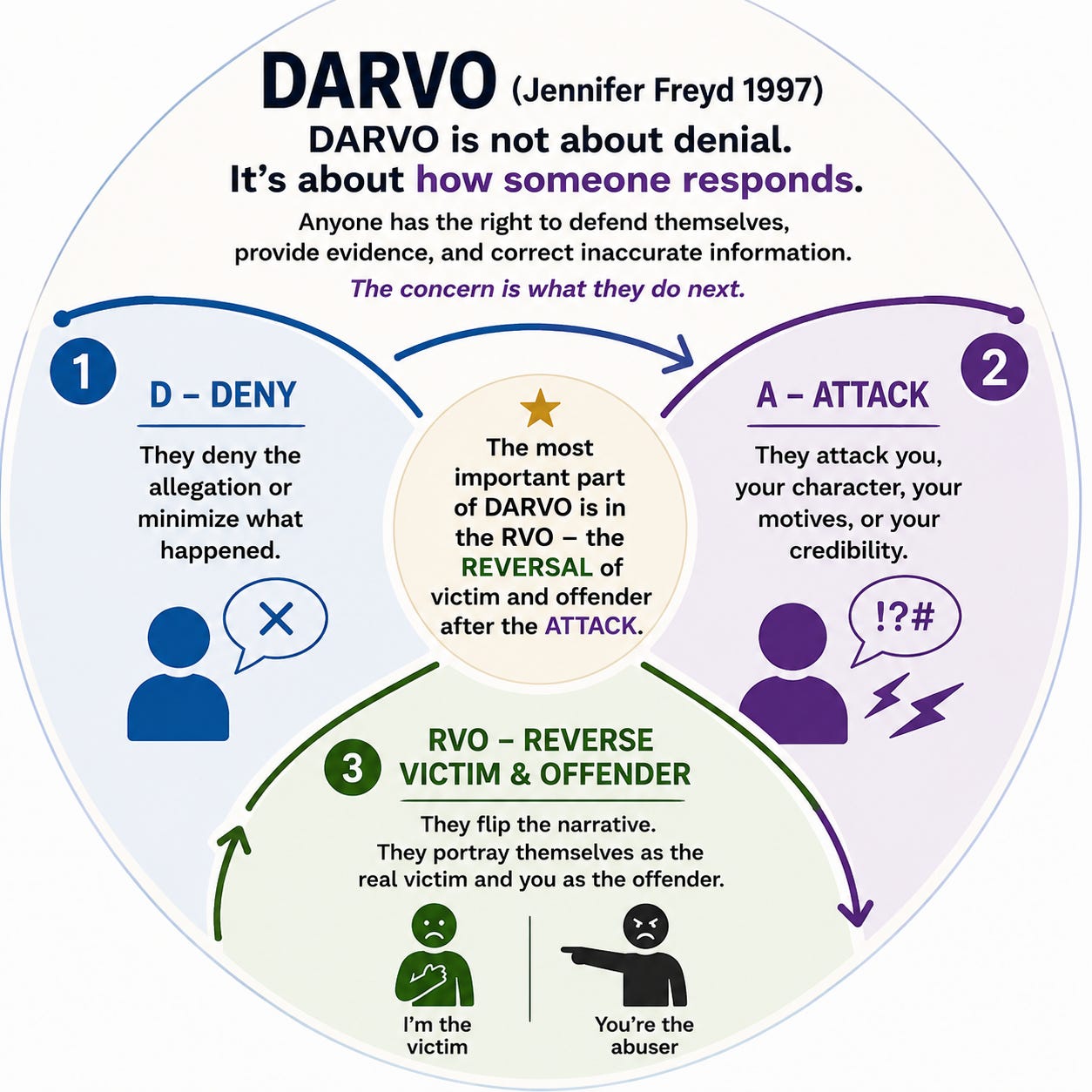
The key part of DARVO is not just the denial.
What matters most is what happens afterwards.
How do they respond while the allegations are being investigated?
Some will deny.
Some may even attack their survivor, but it is what happens next that is important in this equation.
Do they then go on to reverse the roles of the victim and offender?
In other words - do they begin portraying themselves as the true victim whilst casting the person who raised the concerns as an offender?
Someone can deny the allegations and present evidence in their defence. This is not DARVO.
They can even challenge the accuracy of a complaint with statements that show further evidence. This is not DARVO.
DARVO is a pattern in which the accused not only denies and attacks and then goes on to reverse the victim and offender.
It is the role reversal that is the defining feature of DARVO and this role reversal often has the most damaging impact.
Is there a pattern?
After denial:
Does the person attack the individual raising the concern?
Do they try to discredit the victim and undermine their credibility?
Do they pathologise the person who brought forth the investigation as unstable, a liar, a jezebel?
And beyond A of DARVO I think it is important to also think about after the denial:
Do they cooperate with an investigation?
Do they just continue on with life as if the allegations did not happen?
Are they willing to step aside or place their credentials on hold whilst an investigation is happening or do they feel entitled to just keep going?
My pastor, despite the allegations, requested an extension to response time to go through his files (not sure how his files were going to help), and just continued to take the platform in churches, raising $ for his missions organisations.
His response may not be seen as a direct attack on me personally - well, I don’t know what he did say about me actually; I was never told.
But it did certainly feel like another form of attack because I wasn’t taken seriously (a form of pathologisation in my mind) when he was allowed to continue to protect his public image and ministry rather than having his credentials suspended until he responded with transparency.
This is why we need to look beyond just the D of denial and A of Attack.
What happens next?
Do they reverse the victim and offender? (RVO)
Do they portray themselves as the true victim while casting the complainant as the aggressor?
Do they focus on trying to gain public sympathy or are they willing to step back and be transparent with the investigation process?
Do they try to gain allies around them to also attack the person who brought forth their complaint or defend their good character whilst isolating, spreading rumours, or excluding the person who made the disclosure?
It is this role reversal that is the defining feature of DARVO. It is the RVO and what makes DARVO particularly unique and it is what makes DARVO different from simply defending yourself or questioning an allegation.
An accused can deny allegations, present evidence, challenge factual inaccuracies and explain their version of events without engaging with DARVO.
But when the response shifts from addressing the allegations to attacking, building allies around you to also attack, and then to portraying yourself as a real victim and the accused as an offender, this is when we start to see Freyd’s pattern emerge.
Like many psychological concepts, DARVO has become a popular term online. But if we use it to describe every denial or every act of self-defence, we risk losing the value of a framework that has helped many survivors recognise a very specific pattern of manipulation.
In therapy, I love the AND / BOTH principle and I think we can hold two truths at the same time.
People have the right to defend themselves….
AND
We should be careful to not lable every denial as DARVO if the pattern does not continue
AND
We also need to be willing to name it DARVO when a response moves beyond self-defence into attacking the complainant and reversing the roles of victim and offender.
If you have been subjected to DARVO you know how incredibly painful this is. Especially if it has come from someone that you trusted with your life, your healing, or your faith. This is why we name it betrayal trauma.
But I believe as survivors we can work with one layer at a time, sometimes moving between layers back and forth as we rebuild our lives, our autonomy and our relationships with others.
This will be my last substack for a while as i now move on to analysing my data. So you’ll see me disappear off all social media for a while and wont be available for private messages either on social media.
I look forward to coming back with results from my research - whenever that will be.
Another brilliant and very sad article. I hate that this happens...and that it happened to you :( All the best for your research.